Showing posts with label Visual Supports. Show all posts

Wednesday, July 5, 2017

What I Need for My Work Today? (An Executive Functioning Skill)

Preparing for an activity and getting the materials out that you need takes executive functioning skills that can be difficult for young children and students with special needs.  By providing them with a visual support system to prepare for center and desk work students gain the life skills necessary to be responsible and independent!

For example, at the art center, we have a box of supplies for each work area.  In each box, we have the materials students need for art instruction: crayons, markers, glue stick, pencils, colored pencils, and Elmer's glue as well as a What I need for art today tub.


When students come to the art center, they take a look at the What I need for art today board, and get the materials out they need.  Then they set them in their What I need for art today tub and begin their art project so not to be overwhelmed with a full box of supplies.  


Note the board is magnetic and all the visuals for the center are printed on magnet paper for easy use. Also note that I have leveled the visuals for student who are readers, non-readers, and emerging readers.

Because the visuals are all magnetic, we simply post the extras on the metal art supply cabinet so staff can switch them out depending on the daily activity and student needs. 


(Don't have a metal supply cabinet, no problem a cookie sheet can serve the same purpose!)
A similar system is used at the math and reading centers.  The only difference is that the items are stored in pencil bags with a visual on the outside that says what is inside.  The bags are stored in the chair pockets of each student chair.


These systems work so well at centers, I plan to use it for desk work next year as well!  Each student will have a pencil box with needed supplies in their desk to pull from.

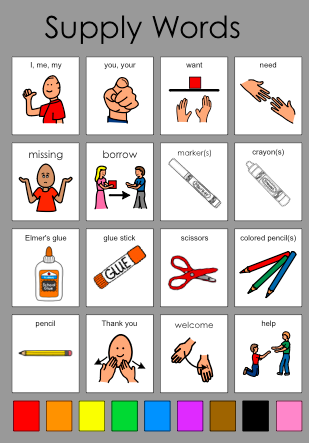
If a student is missing a supply that they need, they can ask to borrow a friends using this matching language board.  A great communication and social opportunity for students!  (Sometimes something we manipulate so a student has to problem solve and practice the skills of asking for what they need.)


Because the visuals remind staff and students what should be in each box or bag, the supply systems also serve as a weekly job for students who are working on problem solving, assembling items, and stocking materials as they check to make sure all supplies are in the boxes and bags and restock as needed using our art supply area pictured below!


To ensure that students have all the crayons and markers they need, I created little checklists for markers, crayons, and pencils.  They are in word form for readers, and picture form for non-readers.


Because the cardboard marker, pencil, and crayon boxes you get them in at the store tend to break.  I tape these checklists to more durable containers to last longer.  I use bar soap containers for our crayons, zipper bags for our markers, small pencil boxes for our colored pencils, and toothbrush holders for our pencils.  The beauty is that this offers students' purposeful opportunities to practice zipping, buttoning, and opening snap containers.

Want to use these supply visuals in your classroom, click here to purchase them from My Teachers Pay Teachers Store!

Until next time- Best Wishes, Lindy

Thursday, November 7, 2013

Using Visual Supports During Large Group

Large group learning activities can be very challenging for both students and staff. It can be difficult to keep the attention of students, especially when they are at varying levels & abilities, and/or they struggle with social activities & experiences. It can be helpful to have visual cues to show students how long the group activity will be. It gives them an understanding of how much work needs to be completed and how long they must be in attendance. 

To support all students I started using more visual cues in my classroom last year, I developed a three box work system.   When the children arrive at large group, we work through three fabric boxes. The boxes are stored in a ClosetMaid bench seat I bought at Target


Each box contains a game, activity, or children’s book specific to that group session. When all three boxes are completed the children know we are finished. Some children need a little additional support in sitting through group so we add a paint stick with three color-coded cubes on it. After completing each box, the children put their cube in the corresponding container. This serves as an individual group schedule to support children in attending. 


We put the schedule on their cube chair


Cube chairs create a great boundary for students during small and large groups. They can also be flipped on their sides as mini-desk areas. Speaking from experience here....they work like magic!!

Sometimes the 1, 2, 3 system is not enough support for students who must sit and wait their turn, especially when activities are highly preferred. As you all know, this is when ants creep into their pants!!  They jump out of their seat insisting on going first. To shape better behavior in waiting for a turn, we have added a wait your turn stick.   It's simply a paint stick with soft Velcro on both sides. Then, we add tokens with pictures or the students' names on them (depending on the students level). Students use it as a visual to know who goes first and when it's his/her turn. They follow the tokens from left to right. As their friends take turns, they place the tokens on the under side of the paint stick to show that friend is finished.


For more circle time tips, tune into my webinar at kansasasd.com on Wednesday, November 13th at 3:30pm CST. Register for the webinar here.  I will be sharing ways to engage students through differentiated instruction, as well as setting up functional errands and movement activities to support students who cannot endure the entire duration of large group. 

Hope to connect with you virtually on the 13th!