Showing posts with label Pre-K Center Idea. Show all posts

Wednesday, November 5, 2014

Creating an ECSE Art Center That Puts the "Fun" in Functional

Finally...a detailed look at our Art Center!!


Over the years the art center has evolved based on student needs and staff growth.  Nope not the size of staff members or an increase in the number of staff, but rather us getting better...thinking smarter not harder! 

Like all the other centers, the students rotate through the art area for 10 to 15 minutes (depending on each student or group of students’ interests and abilities).  See specifics about center rotations by clicking here.

When the students come to art, they always have work to do from Drawer #1 of a three drawer Sterilite system followed by art choices in Drawer #2. 


(Drawer #3 houses specific items for snack as snack is also done at the art table later in the day. The little book bag icon on drawer one is a velcro prompt to remind students to put their finished art work in their book bag.) 

Originally, the idea was work first; then make an art choice.  However over time we recognized, that theory was not always doable. For some of the small groups, all the kids in the group needed one-on-one support to complete the day's art project. Instead we moved to a model in which one student started on the art project of the day, while others did art choices first then the art project of the day.   

As we got going with this technique, Miss Penny, our fabulously talented para whom ran art, became very skilled in knowing which students needed to do the art project first so not to lose their attention and which students needed to have some choice time first and then do their art project.  In some cases, this gave students a chance to see other students doing the art project of the day before it was their turn. In other cases, it reinforced students in working hard on the art project of the day to get to preferred art activities like painting and watercolor.  

If needed she would use our trusty sand timers from watchtimepass.com to prep and prime students for when it was time to change activities!

So let’s dive in with an example of how all this works! With Christmas just around the corner, I decided to take last year’s Christmas art projects as the example.  It is quite the detailed process so stay with me as I share. In the end, I think you will find it very helpful.

First, at the beginning of each thematic unit, we explore thematic art choices. For instance, during our Christmas unit we used holiday cookie cutters, cookie sheets and spatulas to play with play-doh.  


And then holiday stamps, stickers and red and green construction paper as another option to make Christmas cards for friends, teachers and family members. 

Thifty Teacher's Tip: I often pick up crafty holiday items after each holiday at 50% off or more. 

We also try to be creative with art choices for other thematic units. For example, during our dental unit, we used pink play dough and lima beans to make pretend mouths as a counting and fine motor activities.  


(Please use your imagination with this photo as it was taken at home 
and my boys rarely use pink play dough! :) )  

As a second choice, we laminated a large tooth and had the kids draw pretend food on it based on the pretend food they ate on the flash cards and then wiped it clean with a toothbrush.  This idea was adapted from the great work of Tracie Betz. Thanks Tracie!


Thematic choices are provided as well as other constant art materials like colored pencils, markers, watercolors, glue sticks and scissors.  Students can use an aided language board to ask for specific art choices.  


Notice we can mark off materials that are not a choice for the day or we can simply slide in the theme-based choices over the top of our traditional art choices.  


We have found it helpful to have a few constants and then change it up with a few new options related to the theme.  The new options are always introduced and taught on the first day of a new theme.  That day the art choices are housed in Drawer #1 and there are not any choices in Drawer #2.  This is helpful so Miss Penny can model how to play with the choices and expand on creating and making. 

After day one, the art choices move to Drawer #2 and we dive right into art projects for the day.  As I share the art projects we did each day during our three week Christmas unit, I will also share a picture of the prep for each activity. 

I try to be a theme or two ahead so the prep supplies can be in the "to do bucket" for staff.  


Staff then cuts and prepares the art projects for each activity when they have a down moment whether it be an absent student, a student or two receiving speech, occupational, or physical therapy at the same time, or even between classes.  Note: I write exactly how many of each item I need and any other notes on the items for prep and then paperclip them or put them in a Ziploc bag with a sample of the project so staff knows exactly what we need by going to the to do tub and don’t need further instructions while I am working with students. 

Also note it seems like a lot of work, however art projects from year to year are stored in the theme boxes so as I prep for themes I have a lot of examples to pull from.  


It is a process! Over the years I collect more and more ideas for each theme.  We try not to do very many art projects two years in a row as we often have returning students but some of our favorites get used each year and thanks to Pinterest there is always room for improvements and updates.  

Art Project Day 1 - Snowman Count Down: (adapted from a wood project I found on Pinterest)


Snowman Countdown Prep:


Note:  The students’ art projects are not about being the same.  We always have a model for students to look at but we focus on the process rather than the end product. 


We want the students to have a finished project they are proud of but each finished product should have it’s own personality with the student's name on the back.  The beauty being that each student gets practice writing his/her name in a purposeful way almost every day!


I try to plan the art activities so that the ones that can be hung in the hall will be done at the beginning of the theme unit so they can be up for most of the season or theme.  

Art Project for Day 2- Christmas Tree Project:


Note:  This one includes math concepts as the students have to roll a color di to see which color painted lights to put on. 

Christmas Tree Prep:  


Art Project for Day 3 and 4- Santa Claus Project:


Santa Claus Prep:


Depending on the amount of steps in a project, sometimes we divide the project into two days.  For example for the Santa project, on day one the kids cut strips for Santa beard and then clip them together with a clothespin that has their name on it.  Day two they pick out their clothespin of beard strips and glue the Santa project together.


We try to model and support students in using appropriate amounts of glue with these supports as it is a life skill to only use what you need and gain impulse control!  For students who need it, we will use Elmer’s glue stick that goes on purple and dries clear.  Before student use, we will support them in where to put the glue by marking lines or dots with a purple marker to match to.


For students who need help with liquid Elmer’s glue, we will either put some on a paper plate and have them dip the product into the glue or for paper gluing we will use gluebrushes from Discount School Supply or tap and glue caps from Classroom Direct.  


Art Project for Day 5-  Ornament Wreath Project:


This project had the student’s school picture in the middle and was hung on our school Christmas tree in the office.  It is a tradition to have an ornament made by each student to be put on the tree. 

Ornament Wreath Prep: 


Art Project for Day 6- Staff Christmas Cards:

The front:


The inside:  


Note: Staff and students sign one master copy. Then we make 20 to 30 copies to deliver with Christmas cheer (and sometimes Christmas carols) to service providers, other special ed teachers, office staff, cafeteria staff, janitor staff, school nurse, paras, subs, and bus drivers and monitors. 

Staff Christmas Card Prep:


Art Project for Day 7- Wreath Project:


A great one for fine motor as the students put mini red sticker dots on the black dot spots.

Wreath Prep: 


Art Project for Day 8-  Family Christmas Card: (another great Pinterest find by Jill Dubien).


Only prep is to copy the template on card stock and then fold in half.

Art Project for Day 9-  Our Gift to Families, A Traditional Handprinted Glass Ornament:


** It was a class tradition to paint a different glass ornament each year.  You can see past years here. 

Art Project for Day 10 -  Wrapping Paper for the Glass Ornaments:


NOTE: Last year we did patterning with smelly markers. Some years we paint our paper, stamp it or add stickers to it.  Tip: We always precut the paper so it is already to go for the kids at the art center.  Usually, it's butcher paper or old wrapping paper turned inside out.  

Art Project for Day 11 - Wrap Gift  


Instructor's Insight: To help with the wrapping of family gifts, we often use the wrist tape bracelet by Scotch tape.  The staff person wears it and the students pull off each piece of tape.  Not only a great fine motor activity, but it also makes wrapping the gift more independent!

Art Project for Day 12 - Candy Cane Project:


Candy Cane Prep:


And there you have three weeks of Christmas crafts at our first-then art center!  Remember we were a four day per week program with Fridays being a day for consulting with families and daycare centers, as well as IEP meetings and a little planning time. 

I know it seems like a lot but by planning and prepping ahead the kids can be so successful and learn so much.  Just think of all the skills that were taught in this little ten to fifteen minute time of the day: writing their name, counting, matching color, following directions, cutting, coloring, painting among many other fine motor experiences!  Not to mention the opportunity to request.  

For several of the art projects, we will slip the materials needed in these I want bags so the students can point to "I want" and then touch the item in the bag.  


(Note:  In some situations we should change the "I Want" bags to "I need" bags.)

We also use PODD books or our mini language books to support requesting specific colors of materials and writing tools.  


That is it for now!  Until next time happy gluing, cutting, writing, coloring, drawing, and creating!  Get Creative! :)

Best Wishes, 
Lindy

Thursday, August 14, 2014

Our ECSE Classroom's Schedule: Part Two - Centers (8:15 am - 9:40 am)

I am back!  It is 8:15 and time for centers or what we like to call "Learning Rotations".  I stole the term from two amazing educators doing wonderful work here in western Kansas, Teri Berkgren & Dixie Teeter.  They use the term for their older students whom are involved in structured teaching rotations within an inclusive setting. However, I stole the term for our classroom to help parents and staff recognize that although our centers revolve around play activities, they are very much learning opportunities!


Following arrival time, the students begin their 80 to 100 minutes of learning rotations.  Depending on if we get to go outdoors for recess and how many peers and staff groups there are, each rotation is 10 to 15 minutes.  Staff members know which center they will supervise with which student(s) by looking at this magnetic marker board chart. 


It is perfect for staff as the center photos and student pictures are on magnetic dots so we can change the chart as needed when peers or staff are absent. We can write little reminders to staff using a dry erase marker.   

The students know where they are starting learning rotations by the icon or object they are presented through their individual schedules.  I am not going to get into the centers themselves as you can go to each centers link below to see more details.


However I will share a few logistical details about learning rotations.  We have four staff people in the classroom (and sometimes an extra volunteer).  Each person is in charge of two centers.  The students rotate around the room in a clockwise motion. 

Staff have the flexibility to rotate each group through their centers in a way that works for the group.  For example if we are switching adults every 20 minutes, the staff person can choose to have her group at her first center for 12 minutes and then do the other center for 8 minutes.  The whole idea is that we work with the students’ interests and abilities in mind.  Some students even leave the classroom with their paired adult between centers to do a functional errand or two. (I will share more about that later).   
I provide my staff with the tools and flexibility to support the kids however is best for each group. The only stipulation is that the group must work in both centers and complete their work for both centers before the 20 minutes is up and it is time for students to switch adults.  
At which time, we try to sing this song.  It is to the tune of Clementine. Originally I got it from Miss Joelene, an amazing preschool teacher here in Hays, who got it from Mailbox Magazine.  We changed the words a bit so we could work on the transition piece as well as saying goodbye and hello to staff.   
Changing centers, changing centers,
It is time for something new,
Changing centers, changing centers,
It is time to say goodbye to YOU!
Note: When I first started teaching in the special education preschool classroom, my staff and I were each assigned to a student or group of students per day.  We would go with our group to every center with our student or group of students.  We did so simply because I couldn’t wrap my mind around how the kids could possibly transition by themselves.  

With individual schedules and intentional teaching, you would be surprised how quickly the kids picked up on the transitions.  It is also a much better fit for staff.  We don’t all have to learn how to run each center instead we can focus on our expert center.  It also benefits the students as they learn to work with every staff person, every day.  It has also made my job a whole lot easier.  I teach direct instruction for each student so I have the ability to touch base with them every day and really work on their individual IEP goals in a one on one format. 
So there you have it.  It is 10:00 and Learning Rotations are over and it is time for Large Group!  Join me next time for more details.


Tuesday, June 24, 2014

Sensory Center in an ECSE Classroom and 17 Theme-Based Sensory Table Ideas

....And Exhale...The summer is here!! Happy Summer Break!  

Now that the school is over, I have some time to reflect on what an incredible year it was.  I learned so much this year so now it is time to play catch up and share it with all of you!  I always say I learn as much as the kids do. That is the best part of teaching special education. Every new student comes in to teach me something new!

Unfortunately with all the learning that was happening this past semester, Considerate Classroom had to be put on the back burner.  My hope is that this summer I can post lots of topics that will get us geared up for this fall.  I am going to start by sharing the rest of our classroom centers.  

For those of you who are new to this blog, a good place to start is by viewing our classroom tour.  There, you will see how the upcoming center posts  fit into the grand scheme of things.  You can also view past posts on the following centers:

Today, I am going to share our Sensory Center.  It has definitely evolved over the past few years.  To be honest, in the beginning I was a little nervous to even have the center as it can be messy and get kids pretty wound up.  However, with a little structure and training, it is one of our favorites and most effective for teaching self-control, sharing and waiting for a turn.  It also helps some students relax and self-regulate.
 
So first things first...as many of you may remember from a post I did last fall regarding rules and routines, the sensory center like all our other centers has rules to go with it.  


The rules are pretty self-explanatory.  As one might imagine, the rule most violated is "play with the materials in the table and KEEP THEM THERE!".   With this rule there comes natural consequences, I have attached two command hooks on the side of the table that house two little dust pans and brooms.  If the kids get a little out of hand, it is their job to help clean up. 

We have also added some choices to the center.  Students and/or staff can choose to have the sensory filled tub or tubs in the table or on the floor.  


NOTE:  The bottom of the tubs have the rough side of industrial strength velcro attached to them so they adhere to our carpet well and can't be dumped over as easily.  

Sometimes there are two tubes in the sensory center like the first picture and sometimes it is just one large tub like the second picture.  It just depends on what we have in the table and how well our students are sharing.

Having the materials in tubs rather than the bottom of the sensory table serves several purposes.  Some kids have a hard time identifying their boundaries when they are standing up beside the table and play much calmer on the floor.  

In reflecting about this phenomenon, my best guess is that sitting on the floor helps the kids feel more grounded.  For some students, we notice they have less stimming behavior and more appropriate play when sitting on the floor with the tub in front of them.  Another thought is that spilling sand from the tub to the floor is less dramatic than spilling from the tub at table height to the floor.  Making it less likely for them to repeat the behavior. 

That being said, for some kids the sensory materials are a better fit in the table because they are working on standing and walking skills. For others, it's simply a preference to work standing up alongside the table.   Giving both tub location options is a small accommodation that can be made to benefit all.
 
So the next question you may have is "What do you put in the table?".   Well, that pretty much depends on what we are studying.  For example during our fire safety unit it is water and red & orange pieces of craft foam that are shaped like flames. The kids squirt the fire with little squeeze bottles to work on strengthening their fine motor muscles. Then during our Halloween and pumpkin unit, we use plastic pumpkins and white beans and pipe cleaners to serve as pumpkin pulp.   

During color weeks, we use random items of each color like beans, sand, noodles, water, or other materials. For example, during yellow week it was yellow objects in corn kernels. 


The possibilities are endless!!   But here is a list of some of my favorites:

  1. Safety Unit - Random red, yellow, and green items to sort as we learn about what the lights on a traffic light mean.
  2. Fall Unit - Fall leaves plastic or real depending on the weather. We often go hunt for them ourselves and then put them in the table with small sticks, rocks, and plastic forest animals.
  3. Thanksgiving Unit - boats, plastic people and water like the Pilgrims sailing to America or soil, shovels and plastic vegetables like the Native Americans planting crops. 
  4. Gingerbread and Bakery Unit - Two parts salt to one part flour with sifters, baking funnels, and spoons and spatulas or water & plastic gingerbread boys with all the characters from the story to pretend we are crossing the river like in the story.
  5. Christmas Unit - Insta-Snow! or real snow (if we are lucky) with Little People santa, elfs, and reindeer  
  6. Winter Unit - Real snow and spray bottles with colored water and spoons
  7. Artic Unit - Water, bowls of ice I pre-froze to be glaziers and plastic polar animals
  8. Dental Unit- White beans, pink play dough, yarn (for floss) and toothbrushes (without bristles to prevent the kids from being tempted to put them in their mouths).    
  9. Valentines Unit -  Crayola pink sand and conversation eraser hearts, with sifters and spoons
  10. Gardening or Nutrition Unit - Soil, seeds, shovels and plastic vegetables
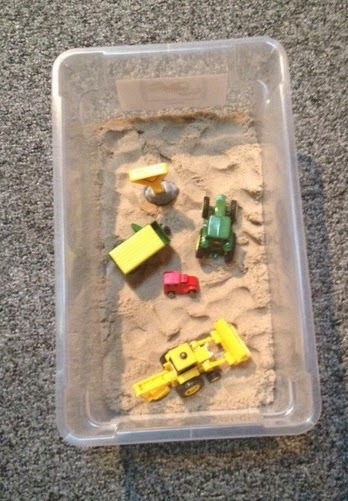
  11. Transportation or career unit - sand and construction vehicles or plastic boats and water
  12. Dinosaur Unit- Moonsand, plastic Easter eggs, and mini plastic dinosaurs to create and hatch dino eggs, or rocks, dirt and plastic dinos 
  13. Easter Unit - A tub full of plastic eggs with magnetic alphabet letters to search for in the eggs or plastic Easter grass and little baskets and eggs
  14. Pet Unit - Little fish nets and plastic fish with water or dog food and plastic dogs
  15. Farm Unit - Homemade farm dirt and tractors, and plastic farm animals.  This Farm dirt recipe is my favorite. I got it from Louise Younger at Wee Friends Preschool years ago when I worked for her during college.  It is still my favorite!  Thanks Louise!

  16. Beach Unit- sand, seashells, and shovels
  17. Bug Unit - Easter grass and plastic bugs, magnifying glasses, and plastic bug jars.  The kids look for bugs that are easy and hard to see as we discuss camouflage. 
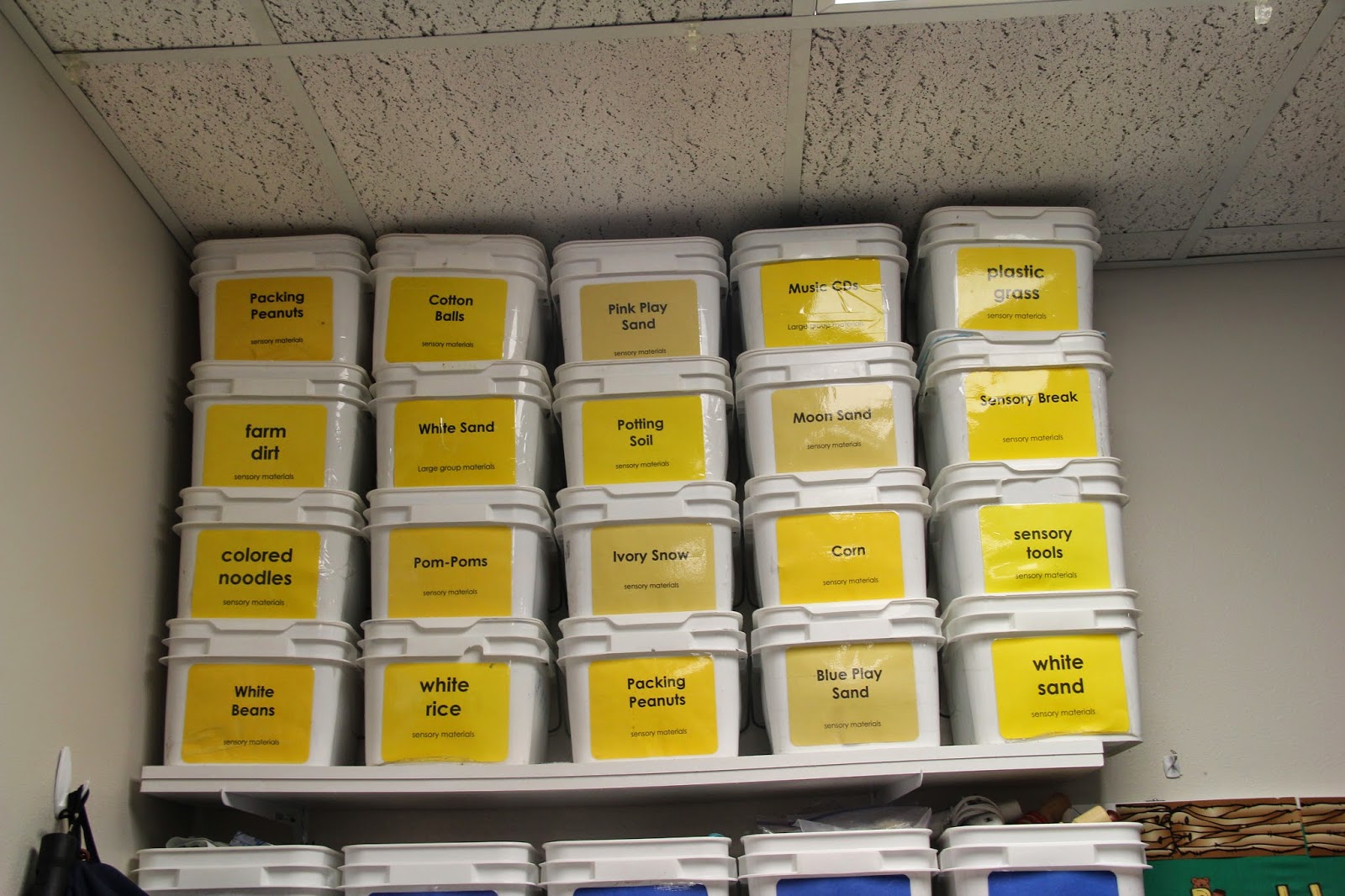
Okay so now you are probably questioning where I store all of these materials while we are not using them.  Well, as you may remember from a previous post on storage, I have trusty buckets from Dillon’s Bakery that store our sensory supplies. Then, all the theme-based materials are in their own themed tubs.   


In my experience, the sensory area is either something the kids love or hate.  Some of the students' favorites to get a positive start to the year are playing with turkey basters and colored water dyed using Crayola color tablets. (You can also use water and food coloring but on occasion your consistency could be too highly concentrated and the kids may stain their clothes or hands) and Brookstone Sand. If you don’t have Brookstone sand,  it is a must have for the sensory table! It is like sand on a beautiful beach with no mess.
  
For those children who love the sensory table, we often have to set limits so they know how long they get to play.  They would stay there all day if we let them so we must set a timer to help them know when their time is up and then also show them when they get to go back.  Some years, I have had kiddos who need it more than once during center rotations.  When this is the case, I have had them start at sensory and then work through their centers at a quicker pace so they end at sensory as well. This rotation technique calms them to start center rotations and also calms them for the next activity which is usually large group.   

On one occasion, I even had a kid who performed best if he got 2-3 minutes at sensory after 7-8 minutes of working proficiently at each center.  This took a little training as other kids and staff had to accept the idea that he needed a little more sensory time and it also required him to learn how to share the sensory area, as well as transition to and from the area appropriately but it was a great way to train him to work hard at various centers and then earn more sensory time.
   
For those that hate the sensory table, even more training and planning are needed.  We have to desensitize them to the experience which can be tricky since we have something different in the area each week.  One thing I have done to help with the process is have a towel or washcloth close by so if the issue is that the kiddos don’t want to get messy we can wipe the mess away quickly.  This is a technique I learned from the staff at the STAR center when I went to visit one of my past students.  

Another technique we use is creating a work system to support the kids in knowing how much work they have and how they can control their behavior to get through the activity sooner.  We set up a work station with 3 to 6 scoops, spoons, shovels or other sensory tools.  We then have the student fill each scoop, shovel or spoon with the sensory material on a near by table and carry them over to the sensory center.  It gets them use to the area. However with some, it has taken all semester or even all year for them to be comfortable enough to play in the table.  

When this is the case, we may have them do a work system using 2 different tools twice a day. But we must plan accordingly, because as you will notice in the video example below, this is a very quick activity so we have to come up with something else to fill the student's 10-15 minute sensory time up.  We typically do that with functional errands. I will share those in a later post.  For now, I want you to see two different videos to see the magic.
 
In Video 1, the student is working toward learning to walk independently and desensitize to the sensory table.  In Video 2, the student is scooping material with a shovel-like tool and dumping it in the table.  Both girls would prefer not to have anything to do with the sensory table and are working on following directions and attending to the table longer.  


So there you have it...some first attempts toward playing at the sensory table!  I am happy to say that both of these gals have made nice progress. By the end of the school year, each would stand by the table and watch or play with staff and peers for 2 to 6 minutes depending on the substance inside and their interest level.   Here's Natalie at the sensory table during the last week of school.  She choose the center independently during free play and stayed for about 3 minutes. 


Huge Progress!!!!  Now she is ready to hit the pool and beach this summer...for a few minutes at least! :)

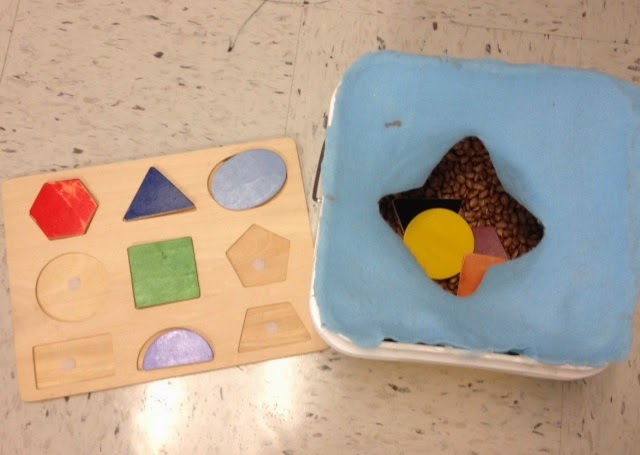
One last tip to adding sensory for kids that are resistant is by adding preferred items to a small container of sand or beans.  Lay the items on top initially and ask the child to pull them out. For example, another one of our little gals loves puzzles so this little sensory bucket was perfect for her. 


First, I placed the pieces on the top of the sensory container. Later, the puzzle pieces were mixed in with the beans.   Notice I hot glued a piece of felt to the top of the container and then cut two slits in it. This technique prevents a little extra spillage. 


Happy summer sensory play until next time!  -- Lindy