Showing posts with label Object Schedule. Show all posts

Saturday, January 4, 2014

Presentation: Visual Schedules & Other Supports in the ECSE Classroom

As promised here is the powerpoint I presented to the Junction City Early Childhood Team on December 20th.  Sorry it is being posted a little later than planned.  Family Christmas festivities got the best of me! :) 


All the slides regarding work systems and work tasks I added after printing the handout are in green. Since we met I also added tips on how to find specific blog entries that were discussed during the presentation in red.   The easiest way to find things on the blog is by searching the month it was created or keyword in the search bar in the right column.  You can also check out my Pinterest board and do an image search.  My tech guru (aka my amazing big sister) is working on better ways to search the blog but this will have to do for now! :)


If you have questions regarding the presentation or any of the blog entries please feel free to email me at considerateclassroom@gmail.com.  I would be happy to share any of my boardmaker files as boards or pdfs just let me know what you would like.  Please note that although the videos I shared at the training are very helpful they are not on this Slideshare.  I have permission from parents and staff to share them at presentations, but unfortunately at this time, I do not have permission to share them on the internet.
   

I would like to thank the TASN Autism and Tertiary BehaviorSupports Project for allowing me the opportunity to share with the Junction City Early Childhood team.  You were a great audience and I wish you all the best in the future.   

Tuesday, August 20, 2013

Using an Object Schedule for Activity Transitions & Separation Anxiety

An object schedule is a simple way to help children transition.  The premise is that the student is given an object that represents the next activity in his/her schedule.  This form of scheduling is used when a student is at a very concrete stage of learning.

Here are some examples of object schedules:
  • To prepare the student for a restroom break, provide the child with a pull up. 
  • To prepare the student for group activity, provide the child with a carpet circle. 
  • To prepare the student for lunch, provide the child a spoon. 
In our classroom, we have organized object schedules in different ways depending on the student's level and the overall class dynamic.  Some years we strategically place baskets containing the objects throughout the classroom providing the staff with easy access.  Other years we simply keep the objects in our aprons.  It usually depends on how many students need to utilize the object schedules.  If we have several students on object schedules, it's difficult to store all the objects in our aprons.
  
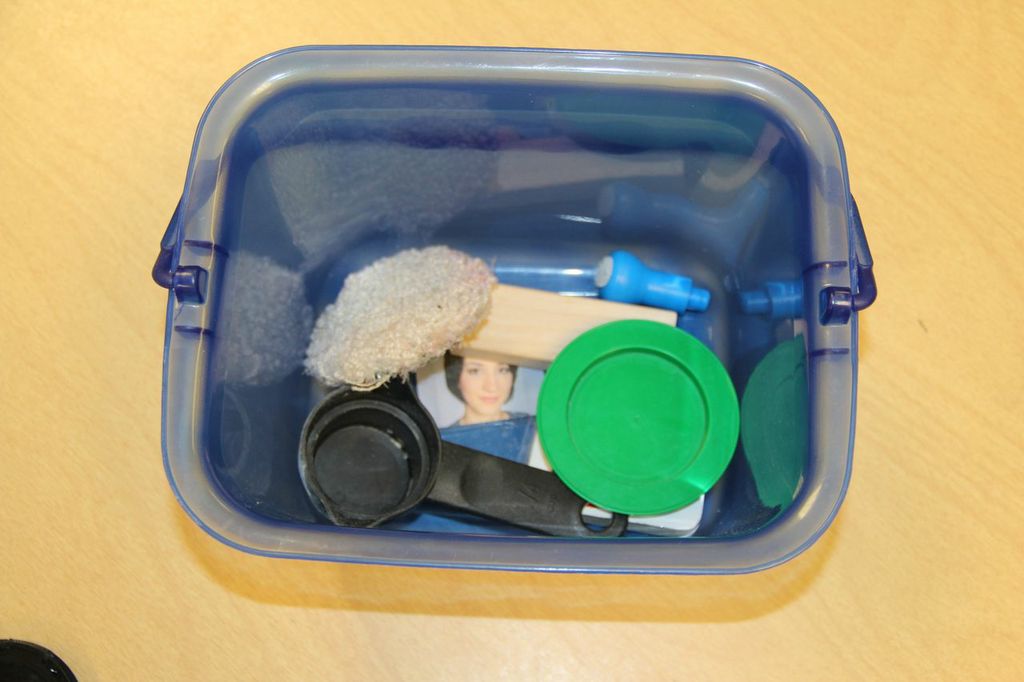
For one of our students last year, we found it helpful to have an object schedule basket specific to her.  As often happens at the beginning of a school year, she had a hard time separating from her mom and would cry most of her school day. By having a basket full of only her objects, we were able to visually demonstrate how much work needed to be completed before mom's return.  

We taped a picture of her mom and a home icon to the inside of her basket.


We then placed all the objects representing the student's daily activities on top of the photos. 

Throughout the day as she completed her activities, she would have fewer objects in her basket.  For this student, each object represented an activity location in the classroom. Once she got to that activity, the object from the basket had a designated spot within the activity location. For example, the mini book represented the library center and was placed in a bowl at the library center during that activity. 


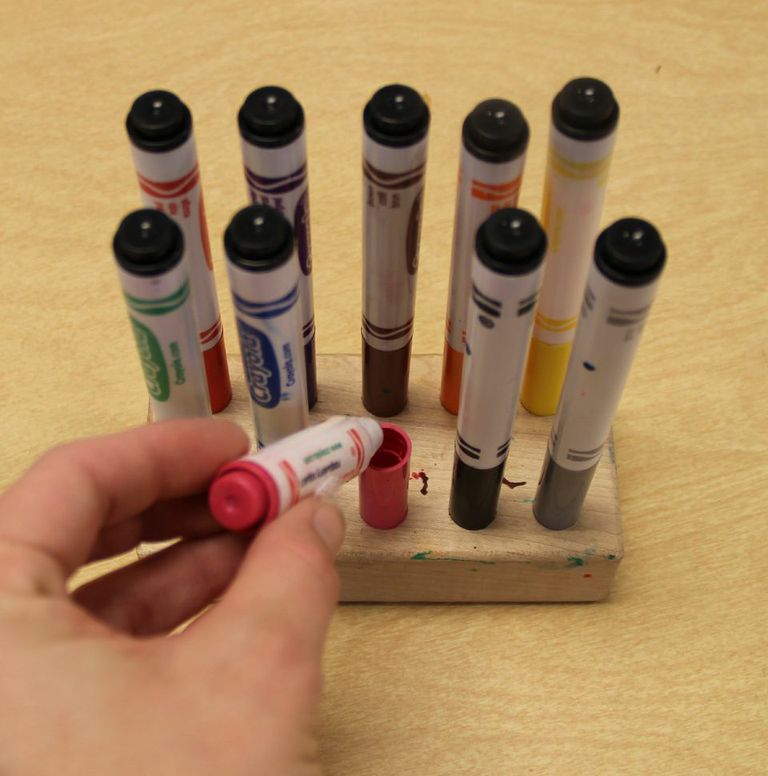
The marker was used to represent the art center  and would be placed in the marker holder during art time.  


Within two days of  implementing this little twist on a traditional object schedule, the little girl began to cry less and was able to perform and participate more appropriately.  

Another trick we used to help with the transition was a watch we adapted to include a picture of mom. 


The student wore it everyday to help her understand that mom would be back.   During the first week, she cried and shouted "momma" throughout her day.  Each time she did this, I would point to my watch and reassure her that momma would return in a little while.  After the first week, the student would cry, shout "momma", and then point to her own wrist as if she was communicating and reassuring herself that momma would return.  The watch with mom’s photo helped her cope with the transition from home to school.