Amy over at Delightfully Dedicated is doing a Summer Series Blog Link Up. This week the topic is the ever dreaded BEHAVIOR!
A lot comes to mind when I think about behavior, but one of the things I think we miss is being intentional about teaching appropriate behavior in a preventative manner. I have done a few posts on Rules and Expectations in the past, but in this one I thought I would share a bit more about how to intentionally teach the rules and expectations of the classroom.
As I have shared before, brain research from Dr. Becky Bailey states that children think in pictures until age 9. By having rules posted at all times, students can start to make connections with what is expected of them.
But sometimes pictures are not enough, especially in a world where technology is at the finger tips of our students in a variety ways. In many cases they prefer to get information from the interactive and fast paced world of computers, iPads and other technology devices. For that matter so do we! When was the last time, you googled how to do something, and purposely clicked the Youtube how to version rather than the word and picture version?
What we expect students to do can be fairly abstract to a young child especially when the rules and expectations are different from what is enforced and expected at home. By sharing video examples of appropriately following the rules, I have found that my students can make connection with what they couldn't connect with or understand in the past!
Which leads me to our morning meeting! Each morning we review the classroom rules and expectations at opening group time via the Smartboard, but before we do so, we share a video model of one way to follow the rules. The video is usually regarding a skill the students struggled with the week before. For example:
Lining Up and Coming In From Recess
Transitioning From One Activity to the Next (and Sharing)
Raising Your Hand at Group Time
and Managing Upset and Frustration in an Appropriate Manner
Or skills and activities that are new to the students, for example:
Using a New Visual Support (for more information about this visual support click here)
or Using a New Communication Support to Request a Break When Upset (for more information about this communication support click here)
Okay, I know what you are thinking. . . these are great, but how do you ensure your students are gaining meaning from the video examples? Well first off, from the students' behavior but secondly from a reflection after watching the video model each day.
The rule helper for the week comes up and shares what rules the video example followed. See a video of how it all comes together below: (The Feeling Buddies in this video come from Conscious Disciplines Feeling Buddy Curriculum.)
So there you have it, Intentionally Teaching Classroom Rules through Video Modeling.
A special thank you to my former student Bryce and his family for allowing me to share this video! As well as my son EJ and his Friend Oaklye for creating a library of video model examples for students to grow and learn from.
A few weeks ago, I had the opportunity to meet Vanessa Levin of Pre-K Pages and Deborah Stewart of Teach Preschool. They "wowed" me with their experiences, love, and excitement for preschool during their presentation entitled, “Wow Your Crowd with a Read Aloud” at NAEYC. As a reflection of their presentation and Vanessa’s blog post dated 11-19-2014, I began to think about the strategies they shared and how they relate to children with developmental disabilities, limited language, social deficits and/or Autism.
The first strategy they discussed was stamina (which I totally bought into to!)They described stamina as the length of time children can listen to a story or look at a book independently. This concept is huge when thinking about children with disabilities. Often attention spans are shorter than typically developing children.
When choosing a read aloud book for my special needs preschool classroom, I always kept the attention span of my lowest level students in mind.In the beginning, our books were very short and using high interests.For those that needed it, I would also incorporate a task strip to help them know how long the book was and how long they would be sitting.
In the book, a frog eats different bugs with his sticky tongue and then gets eaten by a fish at the end of the story.To help students who have a hard time sitting, I would offer them little images of each bug and animal that gets eaten in the story and they would attach it to a task strip.
Although we want our students to be actively engaged during a read aloud with the book itself and the reader, some students are not able to sit and attend without knowing how much work they have to do.The icons and task strip help reduce anxiety and support success as they know exactly how long the story will be.
This strategy is based off of the TEACCH program.The TEACCH program is designed to support children with Autism.The idea is that the activity, in this case a book, is visually structured so the students know how much work they have, and when the work will be finished.
Now moving on to the second strategy shared by Vanessa and Deborah...vocabulary.They shared, "when children understand the vocabulary used in a read aloud they will be more engaged and you will be better able to capture their attention." Makes total sense! However, with some of our special needs students, vocabulary is very limited.
In some situations in order to support a student's understanding of the vocabulary in a read aloud, we play games in small groups or at direct instruction to prepare them for a read aloud later in the day.
For example with The Icky Sticky Frog book, I may have students match photos of the bugs and animals that are in the story to icons of bugs and animals that are in the story.
This helps students generalize that a fish can look like this or like this but it is still a fish.
This activity often helps with IEP goals related to increasing the number of words a students knows, says and/or understands.It also supports the student in making sense of picture icons and photographs so they know that pictures and icons have meaning in order to use them for individual schedules and choice boards.
Leading me to another version of the same thing, for students whom do not yet understand icons we use three-dimensional objects to help with making sense of vocabulary. Here is a sample of a three-dimensional vocabulary task. Instead of matching icons and pictures, the student matches objects to pictures that are magnetically attached to spaces in a muffin tin.
Next up...Repetition.“While reading the same book over and over may not appeal to the adult doing the reading, it is important for increasing comprehension and vocabulary.” –Vanessa Levin
When working with students with special needs, I often introduce new books at direct instruction or in the small group literacy center and then repeat the story as part of read aloud at large group.The idea is that I am setting students up for success.Many students with special needs struggle in large group settings. By introducing a book at small group or during one-on-one direct instruction, I can expose them to a book to support comprehension and prepare them for success in a whole group setting.
Another option is to work on adding imitation and repetitive phrases in small group and in one-on-one settings.Many students with special needs have limited verbal and gross motor imitation skills. By reading a story in a small group setting, I can teach them the words and actions.For example with the Icky Sticky Frog, we could work on sticking our tongues out when the frog does it in the story and/or working on saying “Shhh" or "Shhh, frog didn’t make a sound” when that part comes up in the story.
Do you have a student who is non-verbal?No problem. Program a voice recording button or use the voice memo on your phone or iPad to say the phrase so every time the phrase comes up in the story your non-verbal student can contribute at the same time as their verbal peers.
I prefer to use a voice recording button for this activity, but I figured I would show you with the voice memo on my phone since mobile device and iPads maybe more readily available. Note: You can also tape little visuals in your book where the repetitive phrases come in so students can see when it is their turn visually. A great self control activity to wait for the button visual!
This page also has a velcro bug. We do that in our mini-version as another way for students to interact with the vocabulary, attend to task, and know how long they need to attend to the story. All the characters are on a velcro strip and get pulled off and put into the story as it appears.
Now moving on to other books and a new strategy, Narration.Vanessa Levin shared that “Narrating or retelling helps children understand what a story is about and how story structure works. Children enjoy retelling stories independently in centers using tools and props such as flannel boards and puppets.”
The final strategy is Wordless Picture Books! Vanessa shared in her blog that “Nothing is more interactive, motivating, and engaging than inviting a child to tell you the story they see in the pictures using their own words.”
I totally agree. But what if a student does not have verbal communication? How can it be done then? Through aided language boards!! They are systems I have come to know through the work of Gayle Porter and Linda Burkhardt in their work creating Pragmatic Organizational Dynamic Display. You can see more regarding aided language boards by clicking to this past posts on communication supports. The video below demonstrates my son working through a story using pictures to retell it. Note: To stay with the Icky Sticky Frog theme, I chose to use the book and just place sticky notes over the words.
(Even though my son is not nonverbal, I asked him to play the part so you can get an idea of how it might work.)
Some teachers are reluctant to use visuals such as this because they want their students to talk, rather than point however research shows that visual support facilitate communication. I use aided language boards and other visuals with many students regardless if they have language deficits or not as the support helps the students come up with the words to retell the story and builds literacy. Remember visual supports are easier to fade than verbal ones so if you have to help a student retell the story by doing so with visuals instead of words, they will become independent more quickly!
Hello, Everyone!It is time to say goodbye to our classroom schedule series.As the children come in from outside time, they all find their spot in large group.We then close our day with a daily recap and goodbyes. This is done a few different ways depending on the needs of the students.It changes throughout the year to support novelty and progress.Just think how many behaviors of disengagement would occur if we used the same goodbye process all year.That being said, we do have to have balance.We need to stick with the same goodbye routine long enough for students to understand the pattern and gain skills, but we don’t want it to become predictable and lose student interest.
Therefore, today I will share a few variations on goodbye time. I apologize as they are acted out at our home instead of the classroom but I think you will still get the idea.
Our first version of goodbyes was this goodbye book that encourage waving.
We use construction paper hands attached with a brad to visually show children the waving process. On each page the teacher moves the construction paper hand from side to demonstrate waving.
Originally, we had one large yellow book to share the gross motor movements for each animal in the song. But as certain students struggled with the imitation activity and attending to task, we added a few blue mini-books for those kids to follow along with.
After the Goodbye Ritual Song, each student is called up one at a time to pick the goodbye of his/her choice from the goodbye apron below.
The icons on the apron were ironed after I printed them on t-shirt transfer paper. Following each student's choice, he/she is dismissed to get his/her coat and book bag, and then line up to go home. Note: In all of my goodbye examples, I have the students strategically dismissing after they do something in the front of the group so that their dismissal is staggered and the cubby area does not get to crowded. I say "strategically" because I call kids that have the ability to wait in line longer first while kids whom are better at waiting in their spots get called later. One para waits at the cubbies to help kids get their things to go home and the other sits near the kids at group whom have the hardest time waiting.
Here is a video example of Goodbye Ritual #1. Again, use your imagination as the videos in this post are done in my home with my boys and my husband as the videographer since I no longer have a classroom of my own. :( That being said, I think with a little imagination you will totally get the idea!!
The second version was created last year when we were working on teaching students to notice each other and say goodbye.Each student had a copy of this book.
Note:The children were working on a variety of skills.First, they were learning book handling and literacy skills as they each had their own book to follow along with.Secondly, each page had a colored tape tab to reinforce color recognition and support fine motor skills in turning the pages.Third, they were working on social skills as they found their friends and teachers, and used eye contact, waves, and verbal skills to say goodbye.
One of our students, who struggled with large group activities and looking at books, used this put-in tub with all the students and teachers photographs as her strength and interest was in put-in tasks. It kept her engaged and focused during large group.
Following the book activity, we sang the following goodbye song to each student as the staff modeled saying goodbye and the students learned how to do so. Note the song also works on calling friends and teachers by name and using the appropriate pronoun with names- he/she and his/her.
It's time to say goodbye to Timmy,
It is time to say goodbye to Timmy,
How was his day? How was his day?
He had a ____ day today!
The students then checked out by putting their photo in the tin can that represent how they felt about their day. Did they feel happy, sad, okay, or angry about their day?
Note: We used tin cans for this activity as several of our students enjoyed and were very good at put in tasks. I purchased the tin cans at our local hardware store for $0.99. They are empty paint tins! You can get them in pint and gallon size. We also use them for magnetic games.
Click below to see a video example of Goodbye Ritual #2.
After the students lined up to go home we would sing these words to the tune of "She'll Be Coming Around the Mountain" using early literacy and problem solving skills to add the correct pronouns and people into the song for each child. When the students got used to this version, we then changed it up a little to discuss what type of vehicle the students would be going home in using the magnetic icon below.
Click below to see an video example how Goodbye Ritual #3 works.
Note: A modification you could use if you do not have a magnet door is printing these icons smaller and using a cookie sheet. If you would like either version, send me a message. :)
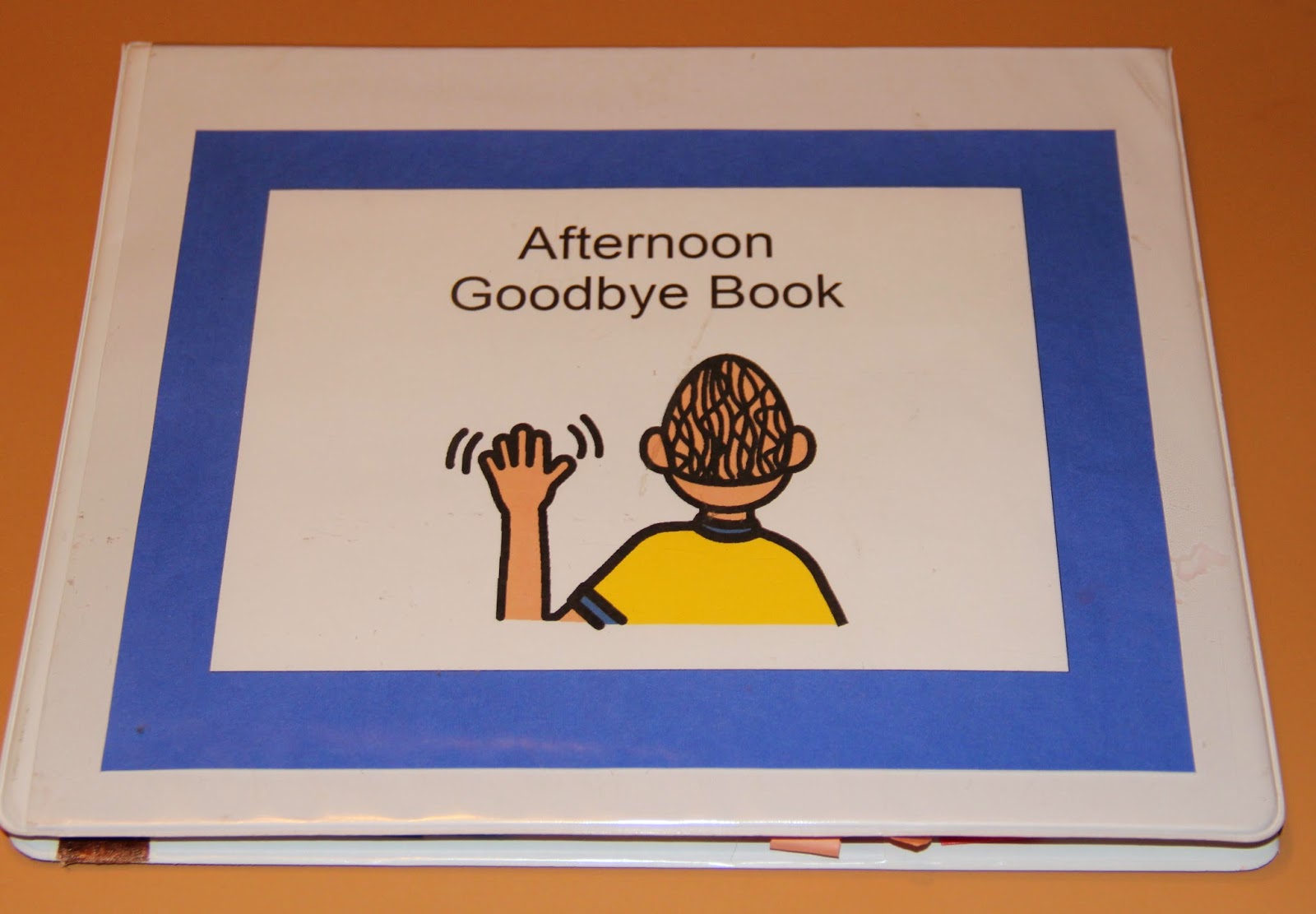
The fourth version I'll share was created for my afternoon students who were returning from the previous year and needed something a little higher level than the goodbye book. In this example, the students worked on spelling their first or last names depending on their level.
You can access the board for this activity on Boardmaker Achieve or by emailing me. The song is sung to the tune of "She'll Be Coming Around the Mountain". To make for easy storage, I placed this goodbye version in a binder using page protectors. The other side of the binder had the morning classes goodbye waving book.
The morning goodbye book was on the front of the binder going vertically and the afternoon goodbye book was on the back going horizontally. Following singing about each student, each student would come up one at a time and check out on an adapted version of a 5 Point Scale by Kari Dunn Buron based on the ideas of Conscious Discipline and the Feeling Buddies.
Click below to see an example of Goodbye Ritual #4.
As the afternoon class matured and made progress, we moved on to other versions of checking out. One was where the students worked throughout the day to earn gold tokens as a class and we then counted the tokens to see if we earned what was in the treasure box at the end of the day. You can see more details about this version by clicking here.
Following the token count, each student signed out at their level using this chart. Some kids wrote the letters of their first name, some put the letters of their name in order, some did a combination of the two and others simply matched letters by color. If they were past working with their first name, we moved them on to their middle and last name.
If you would like a copy of my sign out chart to revamp for your students, let me know!
And last but not least, here is a way I choose to have a K-5 classroom of students say goodbye at a week-long summer school program provided by TASN-ATBS. Throughout the day, the students worked collectively to earn frog tokens. Then at the end of the day, we put them all together and counted them as a class. After seeing how many we earned, each child was responsible for reporting how many they earned using these leveled activities.
Activity 1: (the simplest level) Putting the frog tokens
the class collected in the frog collection jar.
Activity 2: The student reports how he/she feels about getting or not
Activity 3: The student practices reading sight words to say if the class
reached or did not reach their goal. (Their goal was to earn 30 tokens.)
Activity 4: The student reports the exact number of tokens the class earned
by circle the numbers on the chart and then filling then in the box.
Activity 5: The student finds the number the class earned on the 100s chart.
Note that numbers 1 through 29 are red to show the class did not earn
the amount needed for a prize and numbers 30 though 100 are green for go
meaning the students get to open the frog pool with mystery prizes inside.
Activity Six: The student graphs how many tokens were earned on a bar graph
to compare the week's results.
As I mentioned above if the class earned more than 30, they were able to open the frog pool and pick a prize. Usually a choice between two items (bubble gum, fruit snacks, and small candies or party favors). Note: the students do not know what is in the pool each day as there is motivation in the mystery of not knowing what the prize will be for the day!! Each student comes up to report using their leveled activity and then gets to hang it on the chart below and pick their prize for the day (if the tokens were earned for the day). After reporting and picking their prize, they get their belongs and line up for dismissal.
That is it for now... See you later alligator! Until next time, make your goodbyes fun and functional for your students!! Use the time to connect with your students as connecting always pays off. CONNECTION=COOPERATION! As shared by Dr. Becky Bailey, connections on the outside build connections on the inside! Just what we want:)