Showing posts with label ECSE. Show all posts

Tuesday, January 6, 2015

Ringing in the New Year with Effective Classroom Strategies

Happy New Year, Everyone! 

As I support and help others, I find myself referring to these posts time and time again, so I figured what better way to start a new year, then to share them in one collaborative post to support effective learning and teaching in 2015!

First up, A VIRTUAL TOUR OF MY CLASSROOM:  


Physical structure is the foundation of an effective classroom.  A functional learning environment lends itself to smooth transitions, independence and efficient traffic patterns in turn creating optimal learning and teaching time for students and teachers.  

But physical structure does not stand alone, in the world of Early Childhood Education and Special Education we have a lot of stuff.  Stuff that needs to be organized in a systematic manner that provides easy access to teachers and staff but limited access to students, so with that I give you organizational tips from one of my favorite posts: THE NIGHTMARE THAT IS CLASSROOM ORGANIZATION


Next up,  positive and specific CLASSROOM RULES:


Classroom rules help staff be specific and consistent about teaching appropriate classroom behaviors.  But along with them we must develop classroom expectations.  I like to think of classroom expectations as a way for us to systematically teach our students how the classroom rules apply to a variety of centers, activities, routines and situations.  Click CLASSROOM EXPECTATIONS for more details. 


Which leads me to the next stop on our tour of effective classroom strategies, a systematic classroom schedule.  As stated by Kathleen Lane, "The best behavior plan is a good lesson plan." The more planned our routines and schedule are, the more learning we can embedded throughout the day, in turn limiting wait time and increasing quality teach time.  It is definitely a involved process so below you will find links to a series of six posts related to classroom schedules and routines. . .


And finally before I sign off I must, hop on my soapbox, no significant learning can happen without the ability to communicate.  All students must have a means to communicate what they know, as well as their opinion and what they want and need.  In the world of special education and early childhood education this can be a challenging feat as children come to us with the inability to communicate verbally.  It is our responsibility to find them a way to express themselves in whatever means possible.  Visual communication boards are often just the ticket for this, so without further ado I give you, IMPROVING COMMUNICATION THROUGH AIDED LANGUAGE BOARDS and one final favorite, to remind you of all the possibilities:  PERSONALIZING COMMUNICATION FOR INDIVIDUAL SUCCESS.


Best wishes in 2015, as always let me know if you have questions or if I can help in anyway.  The world of Early Childhood Special Education can be a lonely one but together we can make a big difference for our littlest learners!

Happy New Year, Lindy

Wednesday, November 5, 2014

Creating an ECSE Art Center That Puts the "Fun" in Functional

Finally...a detailed look at our Art Center!!


Over the years the art center has evolved based on student needs and staff growth.  Nope not the size of staff members or an increase in the number of staff, but rather us getting better...thinking smarter not harder! 

Like all the other centers, the students rotate through the art area for 10 to 15 minutes (depending on each student or group of students’ interests and abilities).  See specifics about center rotations by clicking here.

When the students come to art, they always have work to do from Drawer #1 of a three drawer Sterilite system followed by art choices in Drawer #2. 


(Drawer #3 houses specific items for snack as snack is also done at the art table later in the day. The little book bag icon on drawer one is a velcro prompt to remind students to put their finished art work in their book bag.) 

Originally, the idea was work first; then make an art choice.  However over time we recognized, that theory was not always doable. For some of the small groups, all the kids in the group needed one-on-one support to complete the day's art project. Instead we moved to a model in which one student started on the art project of the day, while others did art choices first then the art project of the day.   

As we got going with this technique, Miss Penny, our fabulously talented para whom ran art, became very skilled in knowing which students needed to do the art project first so not to lose their attention and which students needed to have some choice time first and then do their art project.  In some cases, this gave students a chance to see other students doing the art project of the day before it was their turn. In other cases, it reinforced students in working hard on the art project of the day to get to preferred art activities like painting and watercolor.  

If needed she would use our trusty sand timers from watchtimepass.com to prep and prime students for when it was time to change activities!

So let’s dive in with an example of how all this works! With Christmas just around the corner, I decided to take last year’s Christmas art projects as the example.  It is quite the detailed process so stay with me as I share. In the end, I think you will find it very helpful.

First, at the beginning of each thematic unit, we explore thematic art choices. For instance, during our Christmas unit we used holiday cookie cutters, cookie sheets and spatulas to play with play-doh.  


And then holiday stamps, stickers and red and green construction paper as another option to make Christmas cards for friends, teachers and family members. 

Thifty Teacher's Tip: I often pick up crafty holiday items after each holiday at 50% off or more. 

We also try to be creative with art choices for other thematic units. For example, during our dental unit, we used pink play dough and lima beans to make pretend mouths as a counting and fine motor activities.  


(Please use your imagination with this photo as it was taken at home 
and my boys rarely use pink play dough! :) )  

As a second choice, we laminated a large tooth and had the kids draw pretend food on it based on the pretend food they ate on the flash cards and then wiped it clean with a toothbrush.  This idea was adapted from the great work of Tracie Betz. Thanks Tracie!


Thematic choices are provided as well as other constant art materials like colored pencils, markers, watercolors, glue sticks and scissors.  Students can use an aided language board to ask for specific art choices.  


Notice we can mark off materials that are not a choice for the day or we can simply slide in the theme-based choices over the top of our traditional art choices.  


We have found it helpful to have a few constants and then change it up with a few new options related to the theme.  The new options are always introduced and taught on the first day of a new theme.  That day the art choices are housed in Drawer #1 and there are not any choices in Drawer #2.  This is helpful so Miss Penny can model how to play with the choices and expand on creating and making. 

After day one, the art choices move to Drawer #2 and we dive right into art projects for the day.  As I share the art projects we did each day during our three week Christmas unit, I will also share a picture of the prep for each activity. 

I try to be a theme or two ahead so the prep supplies can be in the "to do bucket" for staff.  


Staff then cuts and prepares the art projects for each activity when they have a down moment whether it be an absent student, a student or two receiving speech, occupational, or physical therapy at the same time, or even between classes.  Note: I write exactly how many of each item I need and any other notes on the items for prep and then paperclip them or put them in a Ziploc bag with a sample of the project so staff knows exactly what we need by going to the to do tub and don’t need further instructions while I am working with students. 

Also note it seems like a lot of work, however art projects from year to year are stored in the theme boxes so as I prep for themes I have a lot of examples to pull from.  


It is a process! Over the years I collect more and more ideas for each theme.  We try not to do very many art projects two years in a row as we often have returning students but some of our favorites get used each year and thanks to Pinterest there is always room for improvements and updates.  

Art Project Day 1 - Snowman Count Down: (adapted from a wood project I found on Pinterest)


Snowman Countdown Prep:


Note:  The students’ art projects are not about being the same.  We always have a model for students to look at but we focus on the process rather than the end product. 


We want the students to have a finished project they are proud of but each finished product should have it’s own personality with the student's name on the back.  The beauty being that each student gets practice writing his/her name in a purposeful way almost every day!


I try to plan the art activities so that the ones that can be hung in the hall will be done at the beginning of the theme unit so they can be up for most of the season or theme.  

Art Project for Day 2- Christmas Tree Project:


Note:  This one includes math concepts as the students have to roll a color di to see which color painted lights to put on. 

Christmas Tree Prep:  


Art Project for Day 3 and 4- Santa Claus Project:


Santa Claus Prep:


Depending on the amount of steps in a project, sometimes we divide the project into two days.  For example for the Santa project, on day one the kids cut strips for Santa beard and then clip them together with a clothespin that has their name on it.  Day two they pick out their clothespin of beard strips and glue the Santa project together.


We try to model and support students in using appropriate amounts of glue with these supports as it is a life skill to only use what you need and gain impulse control!  For students who need it, we will use Elmer’s glue stick that goes on purple and dries clear.  Before student use, we will support them in where to put the glue by marking lines or dots with a purple marker to match to.


For students who need help with liquid Elmer’s glue, we will either put some on a paper plate and have them dip the product into the glue or for paper gluing we will use gluebrushes from Discount School Supply or tap and glue caps from Classroom Direct.  


Art Project for Day 5-  Ornament Wreath Project:


This project had the student’s school picture in the middle and was hung on our school Christmas tree in the office.  It is a tradition to have an ornament made by each student to be put on the tree. 

Ornament Wreath Prep: 


Art Project for Day 6- Staff Christmas Cards:

The front:


The inside:  


Note: Staff and students sign one master copy. Then we make 20 to 30 copies to deliver with Christmas cheer (and sometimes Christmas carols) to service providers, other special ed teachers, office staff, cafeteria staff, janitor staff, school nurse, paras, subs, and bus drivers and monitors. 

Staff Christmas Card Prep:


Art Project for Day 7- Wreath Project:


A great one for fine motor as the students put mini red sticker dots on the black dot spots.

Wreath Prep: 


Art Project for Day 8-  Family Christmas Card: (another great Pinterest find by Jill Dubien).


Only prep is to copy the template on card stock and then fold in half.

Art Project for Day 9-  Our Gift to Families, A Traditional Handprinted Glass Ornament:


** It was a class tradition to paint a different glass ornament each year.  You can see past years here. 

Art Project for Day 10 -  Wrapping Paper for the Glass Ornaments:


NOTE: Last year we did patterning with smelly markers. Some years we paint our paper, stamp it or add stickers to it.  Tip: We always precut the paper so it is already to go for the kids at the art center.  Usually, it's butcher paper or old wrapping paper turned inside out.  

Art Project for Day 11 - Wrap Gift  


Instructor's Insight: To help with the wrapping of family gifts, we often use the wrist tape bracelet by Scotch tape.  The staff person wears it and the students pull off each piece of tape.  Not only a great fine motor activity, but it also makes wrapping the gift more independent!

Art Project for Day 12 - Candy Cane Project:


Candy Cane Prep:


And there you have three weeks of Christmas crafts at our first-then art center!  Remember we were a four day per week program with Fridays being a day for consulting with families and daycare centers, as well as IEP meetings and a little planning time. 

I know it seems like a lot but by planning and prepping ahead the kids can be so successful and learn so much.  Just think of all the skills that were taught in this little ten to fifteen minute time of the day: writing their name, counting, matching color, following directions, cutting, coloring, painting among many other fine motor experiences!  Not to mention the opportunity to request.  

For several of the art projects, we will slip the materials needed in these I want bags so the students can point to "I want" and then touch the item in the bag.  


(Note:  In some situations we should change the "I Want" bags to "I need" bags.)

We also use PODD books or our mini language books to support requesting specific colors of materials and writing tools.  


That is it for now!  Until next time happy gluing, cutting, writing, coloring, drawing, and creating!  Get Creative! :)

Best Wishes, 
Lindy
Tuesday, October 14, 2014

A Special Look at Data Collection from a Guest Teacher, Ms. Stephanie Kramer!

Today, I am welcoming Ms. Stephanie Kramer as a guest blogger to discuss a very important topic and one I am not very strong in...DATA COLLECTION!  

Ms. Kramer has come up with an excellent method to assess all her students in all developmental areas three times a year.  I could not be more proud and excited to share this post as Stephanie was my student teacher four years ago.  She is a phenomenal teacher, and wonderful friend & colleague who so passionate in her work with children.  So without further ado, it is my pleasure to share Ms. Stephanie Kramer’s expertise.

As a new teacher, I needed to create a progress monitoring/data collection system that was quick to administer.  I wanted it to provide valuable and reliable information that was easily read and understood by parents. I was really fortunate to have many, many resources to work from as I pulled my data collection forms together.  I utilized materials from college, the state standards, and various curriculum's that we use: Handwriting Without Tears, Read it Once Again, ZooPhonics, and some aspects of: Creative Curriculum, and High Scopemy Mom, past teachers, co-workers, and anywhere else I get my hands on data collection forms and ideas!  

Initially all of the many, many documents I collected were very overwhelming, but I slowly began to condense, combine, and reformat the stacks of pages to create an organized system that is teacher, student, and parent friendly.  The system works well in our classroom and the best part is it is included in our daily routine. 

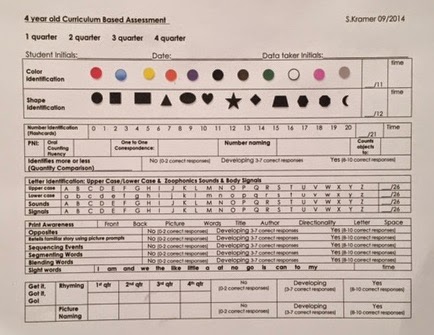
First off, the three and four year old Curriculum Based Assessment (CBA) forms. If I had to select one part of my data collection process that I find most useful, this form would be it!  


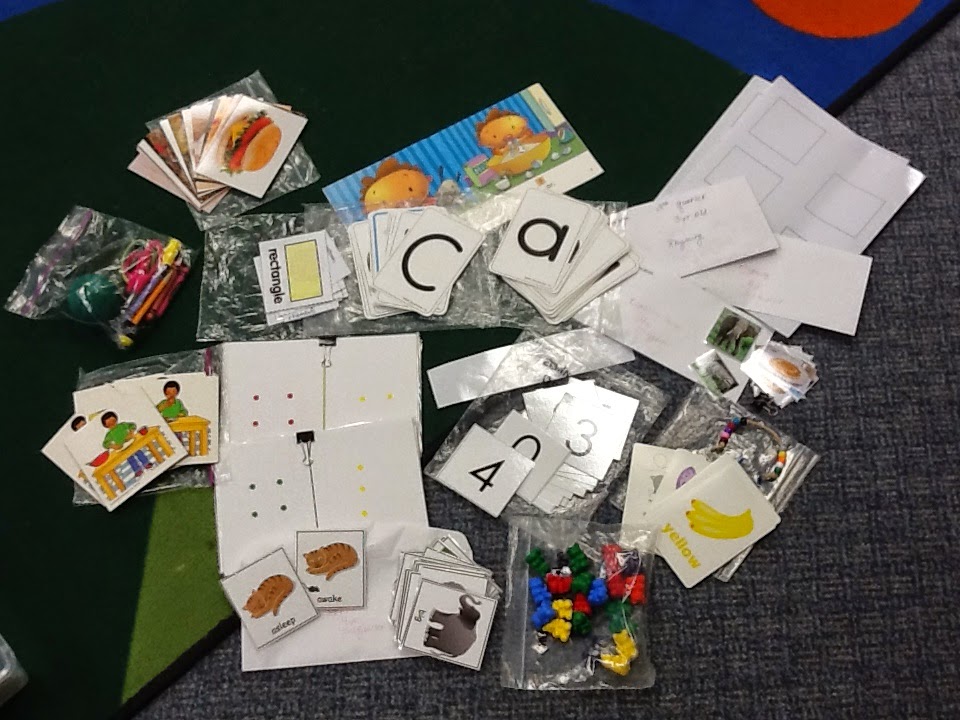
To gather the data needed to complete each 9 week CBA, we have all the items and manipulatives in a small tote.  Below you can see what types of items we use. 


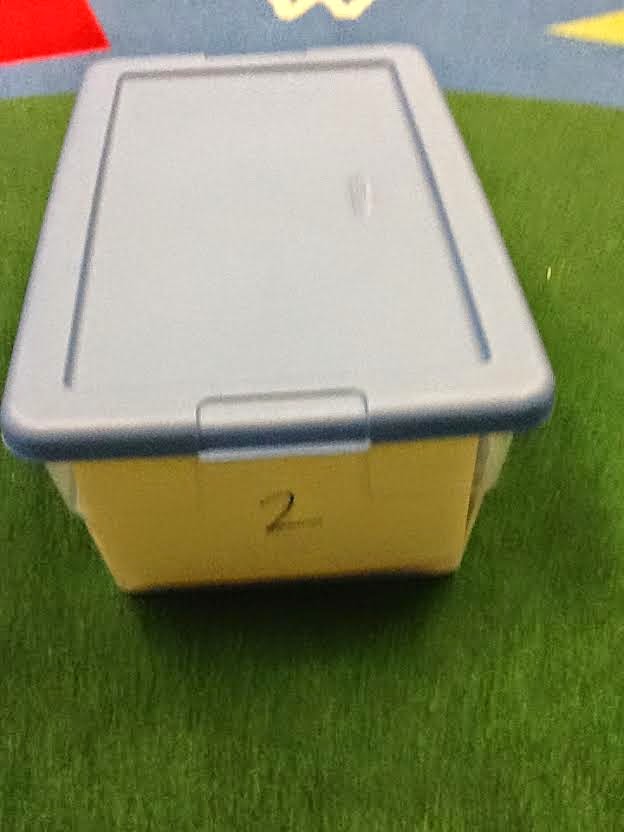
We have a tote for each quarter so that we know the students have generalized the skills and are not learning to the test. 


As you may have noticed on the CBA forms, all 4 quarters are listed at the top.  We use a new form for each quarter and simply mark which quarter the form is being used for.  This allows my staff and I to quickly compare data and note any changes in student performance, making for very parent friendly forms to share during conferences and meetings.  The goal is that by the end of the year, students will have been exposed to every concept on the CBA form and current levels of performance would be evident based on the students performance and data collected. 


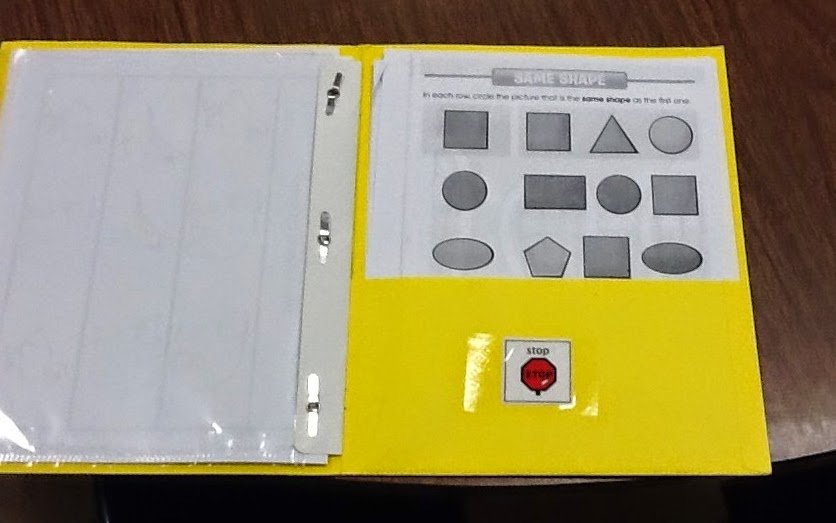
So how do we keep it all organized and provide students with an opportunity to work on target areas on the CBA each day?  We have a morning and afternoon class so we use our school colors to designate between classes.  The morning class has yellow folders and the afternoon class has blue folders.
 

Each folder contains a sheet protector with the pages only the teacher should write on in the sheet protector.  These pages are our CBA forms and another set of forms I will get to at the end of this post.   


As the students complete their work samples/data collection forms in their data collection folders, we file them  into their portfolios so that the data collection folders stay very organized and student friendly.  In the page protector section, we also have the following forms to collect data in regard to gross motor, fine motor, personal information, body part recognition, name writing, self- portrait drawing and other specific things we track related to the curriculum and programs our district has choose to adopt. 
The front pocket holds pages for the student to work on. They are denoted with a green light as a visual prompt for student to know they need to work on the items in this pocket. 


The back pocket is labeled with a stop sign and contains pages that are to be completed within the quarter when a teacher moves them to the front pocket and the students are ready for them.  This system has been adapted and modified so that every student in our ECSE classroom participates and does so as independently as possible.  


We complete the data collection packet by doing our "folder jobs" as part of our opening routine.  With each student's name and/or photo on their folder, the students are responsible for locating their folder and pencil in our pocket chart and then getting to work.


Choice time is the following activity, which proves to be motivational when implemented in conjunction with our classroom behavior management system that encourages students to always do their best. It also provides my staff and I some time to help individual kids when needed while other students move on to choice time.  


NOTE: Some student worksheets require more one on one time with teachers than others so we'll only place 1 or 2 of those forms in the front pocket each day while other students work on independent forms.  We also support students in working on various concept worksheets during arrival job time, small group centers.

Then as students progress, we incorporate some folder work into our independent work time.  Here is what that looks like in the classroom. 


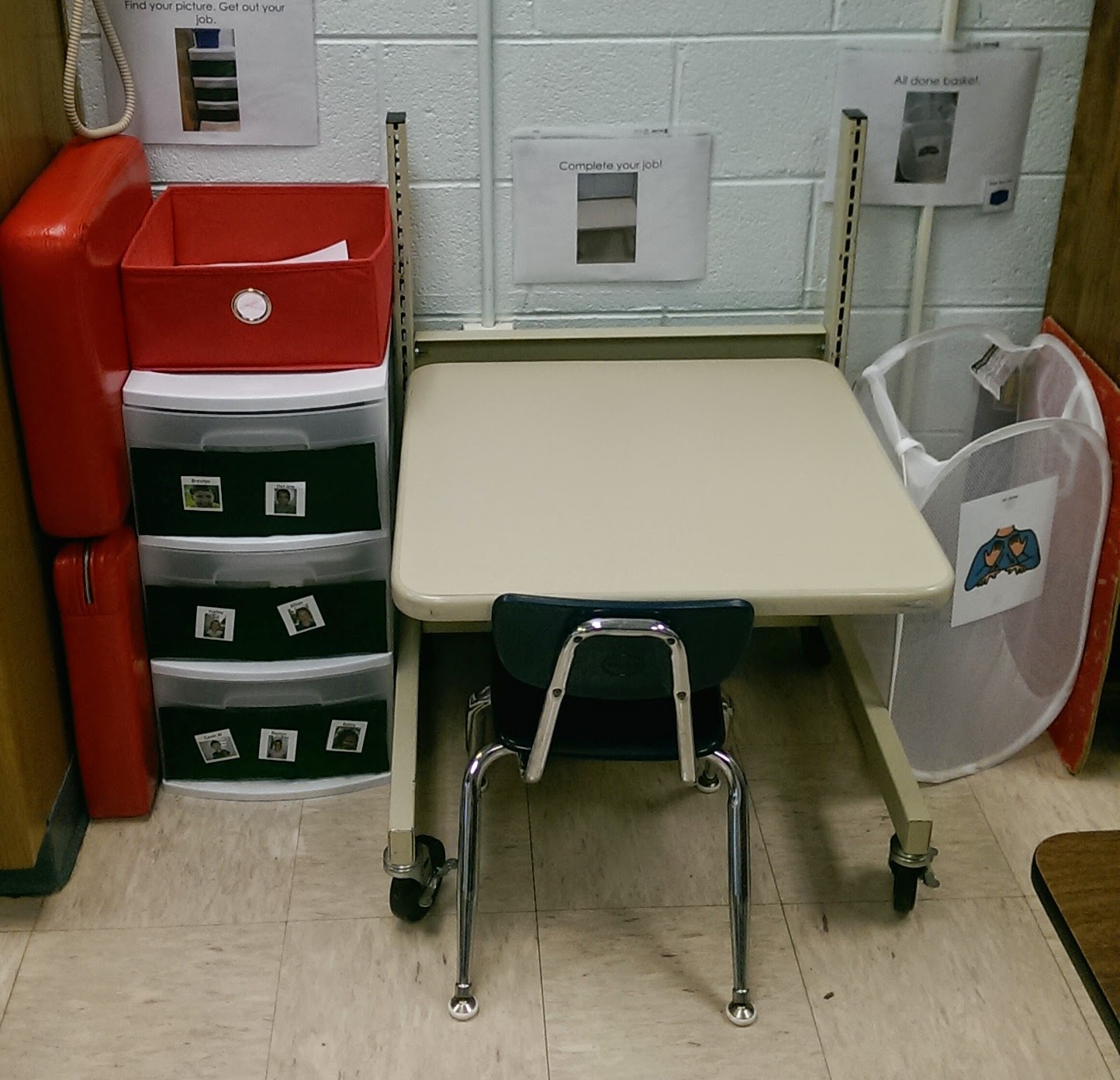
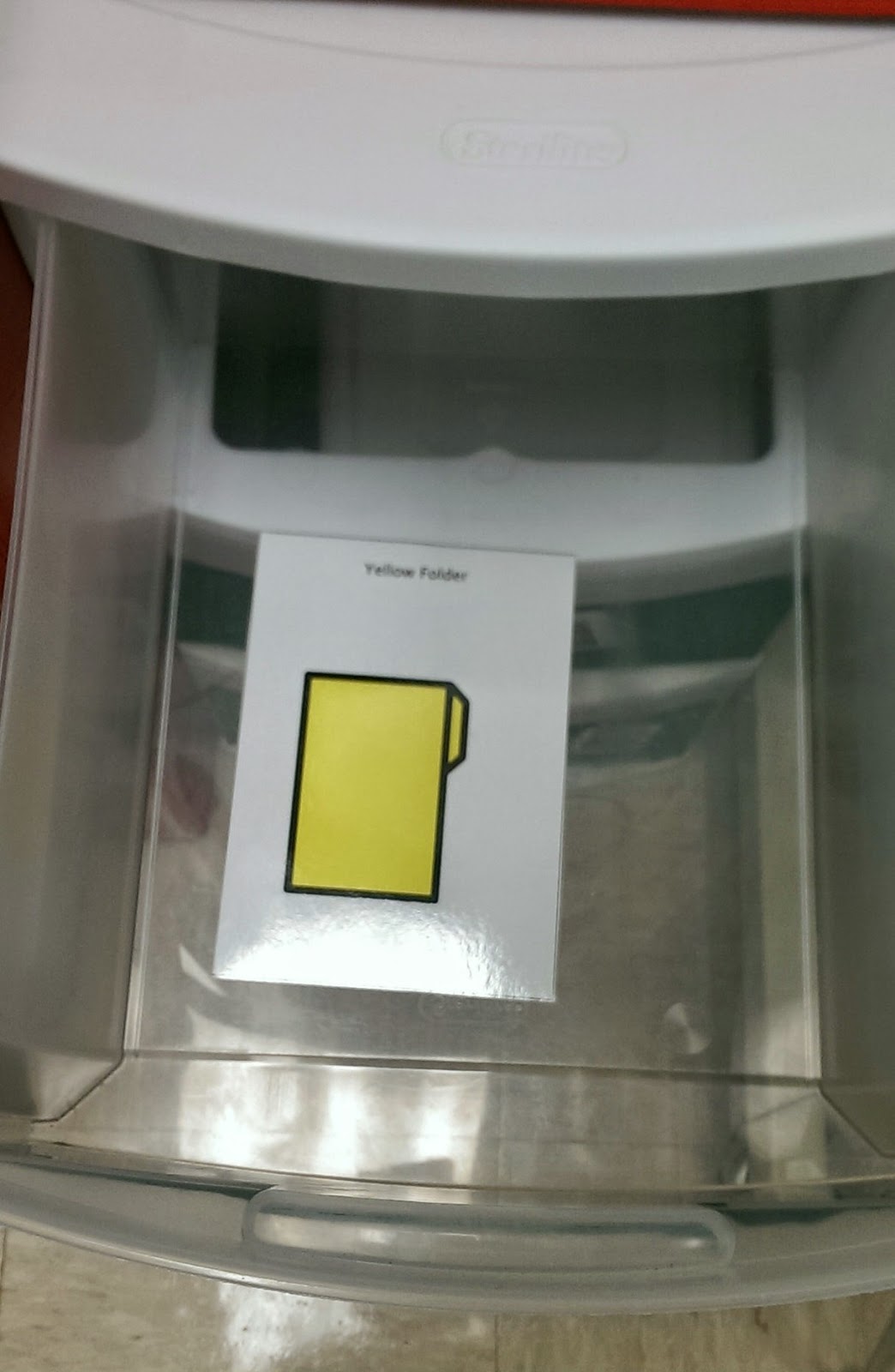
We have 3 drawers that contain a job for each student and if they need to do a folder job, we simply place a photo of a blue or yellow folder in the drawer.


Please feel free to ask me questions about this system at skramer20@gmail.com!  I've learned so much from reading blogs, observing, and listening to other professionals.  Although this system may not work for you exactly as I've explained, tweak it, make it your own and if you have time share the changes you've made with us.  We would love to hear your ideas! 

Now if you're still reading this, I'm done rambling.  I am incredibly humbled and honored to share my ideas with others and want to leave you with a huge THANK YOU for the infinite and invaluable time, endless dedication, and unrelenting passion you spend preparing and working with young children!  I wish you well in your data collection journey! 

Sincerely, 

Miss Steph