Hello, Everyone! It is time to say goodbye to our classroom schedule series. As the children come in from outside time, they all find their spot in large group. We then close our day with a daily recap and goodbyes.
This is done a few different ways depending on the needs of the students. It changes throughout the year to support novelty and progress. Just think how many behaviors of disengagement would occur if we used the same goodbye process all year. That being said, we do have to have balance. We need to stick with the same goodbye routine long enough for students to understand the pattern and gain skills, but we don’t want it to become predictable and lose student interest.
This is done a few different ways depending on the needs of the students. It changes throughout the year to support novelty and progress. Just think how many behaviors of disengagement would occur if we used the same goodbye process all year. That being said, we do have to have balance. We need to stick with the same goodbye routine long enough for students to understand the pattern and gain skills, but we don’t want it to become predictable and lose student interest.
Therefore, today I will share a few variations on goodbye time. I apologize as they are acted out at our home instead of the classroom but I think you will still get the idea.
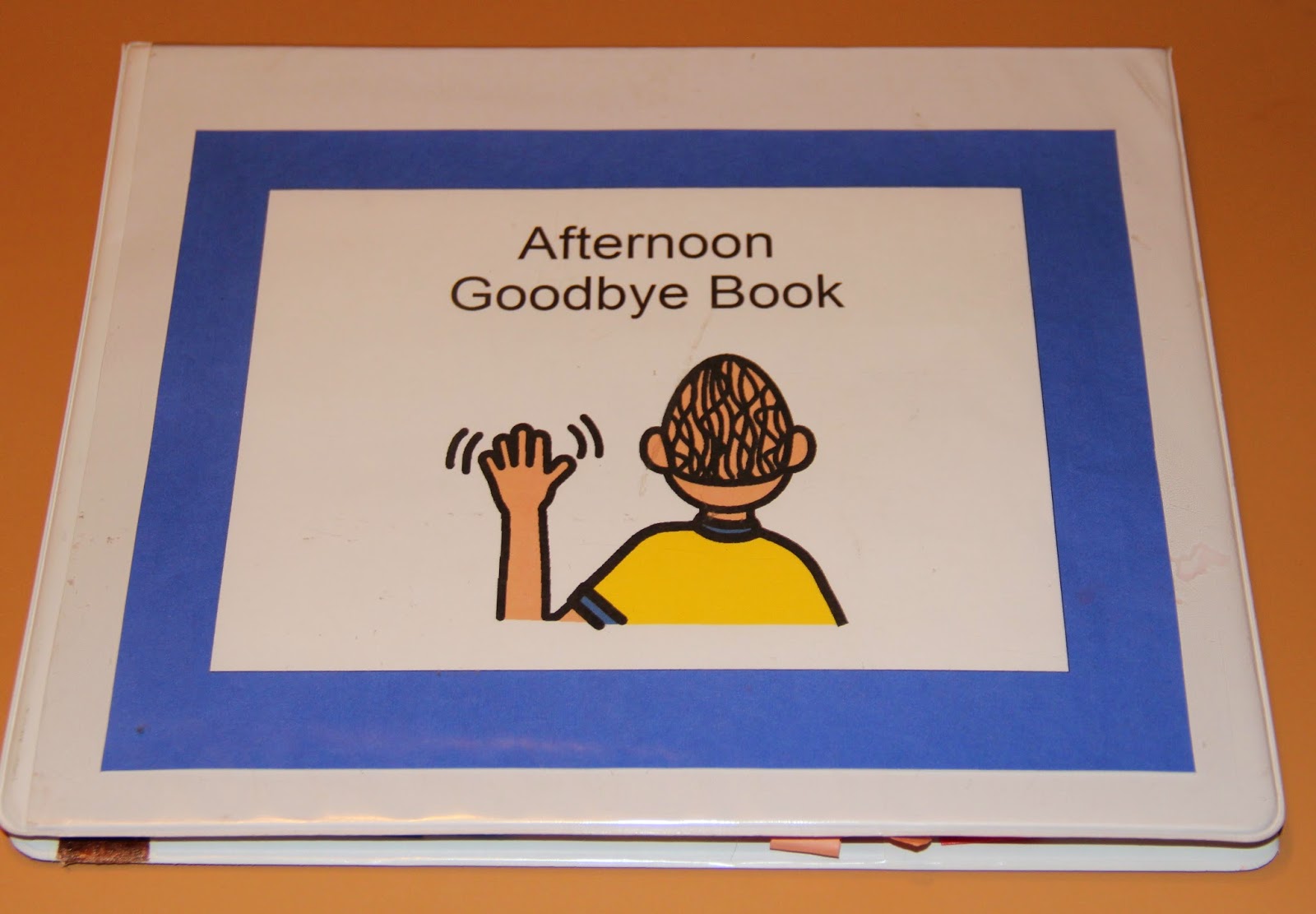
Our first version of goodbyes was this goodbye book that encourage waving.

We use construction paper hands attached with a brad to visually show children the waving process. On each page the teacher moves the construction paper hand from side to demonstrate waving.

Followed by the Goodbye Ritual song from Conscious Discipline’s I Love Ritual CD-Volume 2 . Note: I paired the Goodbye Ritual Song up with a powerpoint and social narrative of my son and his friend doing the actions to the song so that our students that had difficulty imitating gross motor movements would have a still life visual.

Originally, we had one large yellow book to share the gross motor movements for each animal in the song. But as certain students struggled with the imitation activity and attending to task, we added a few blue mini-books for those kids to follow along with.


After the Goodbye Ritual Song, each student is called up one at a time to pick the goodbye of his/her choice from the goodbye apron below.

The icons on the apron were ironed after I printed them on t-shirt transfer paper.
Following each student's choice, he/she is dismissed to get his/her coat and book bag, and then line up to go home. Note: In all of my goodbye examples, I have the students strategically dismissing after they do something in the front of the group so that their dismissal is staggered and the cubby area does not get to crowded.
I say "strategically" because I call kids that have the ability to wait in line longer first while kids whom are better at waiting in their spots get called later. One para waits at the cubbies to help kids get their things to go home and the other sits near the kids at group whom have the hardest time waiting.
Here is a video example of Goodbye Ritual #1. Again, use your imagination as the videos in this post are done in my home with my boys and my husband as the videographer since I no longer have a classroom of my own. :( That being said, I think with a little imagination you will totally get the idea!!
The second version was created last year when we were working on teaching students to notice each other and say goodbye. Each student had a copy of this book.

Note: The children were working on a variety of skills. First, they were learning book handling and literacy skills as they each had their own book to follow along with. Secondly, each page had a colored tape tab to reinforce color recognition and support fine motor skills in turning the pages. Third, they were working on social skills as they found their friends and teachers, and used eye contact, waves, and verbal skills to say goodbye.

One of our students, who struggled with large group activities and looking at books, used this put-in tub with all the students and teachers photographs as her strength and interest was in put-in tasks. It kept her engaged and focused during large group.

Following the book activity, we sang the following goodbye song to each student as the staff modeled saying goodbye and the students learned how to do so. Note the song also works on calling friends and teachers by name and using the appropriate pronoun with names- he/she and his/her.
It's time to say goodbye to Timmy,
It is time to say goodbye to Timmy,
How was his day? How was his day?
He had a ____ day today!
The students then checked out by putting their photo in the tin can that represent how they felt about their day. Did they feel happy, sad, okay, or angry about their day?


Note: We used tin cans for this activity as several of our students enjoyed and were very good at put in tasks. I purchased the tin cans at our local hardware store for $0.99. They are empty paint tins! You can get them in pint and gallon size. We also use them for magnetic games.
Click below to see a video example of Goodbye Ritual #2.
The third version is one I created a few years back based on the literacy work of Patti King-Debaun and Creative Communicating. At that time, our external doorway was magnetic so I posted these magnetic icons on the door. They are Boardmaker files that were printed on magnetic paper.

After the students lined up to go home we would sing these words to the tune of "She'll Be Coming Around the Mountain" using early literacy and problem solving skills to add the correct pronouns and people into the song for each child.
When the students got used to this version, we then changed it up a little to discuss what type of vehicle the students would be going home in using the magnetic icon below.

Click below to see an video example how Goodbye Ritual #3 works.
Note: A modification you could use if you do not have a magnet door is printing these icons smaller and using a cookie sheet. If you would like either version, send me a message. :)

The fourth version I'll share was created for my afternoon students who were returning from the previous year and needed something a little higher level than the goodbye book. In this example, the students worked on spelling their first or last names depending on their level.

You can access the board for this activity on Boardmaker Achieve or by emailing me. The song is sung to the tune of "She'll Be Coming Around the Mountain".
To make for easy storage, I placed this goodbye version in a binder using page protectors. The other side of the binder had the morning classes goodbye waving book.

Following singing about each student, each student would come up one at a time and check out on an adapted version of a 5 Point Scale by Kari Dunn Buron based on the ideas of Conscious Discipline and the Feeling Buddies.

Click below to see an example of Goodbye Ritual #4.
As the afternoon class matured and made progress, we moved on to other versions of checking out. One was where the students worked throughout the day to earn gold tokens as a class and we then counted the tokens to see if we earned what was in the treasure box at the end of the day. You can see more details about this version by clicking here.
Following the token count, each student signed out at their level using this chart. Some kids wrote the letters of their first name, some put the letters of their name in order, some did a combination of the two and others simply matched letters by color. If they were past working with their first name, we moved them on to their middle and last name.


And last but not least, here is a way I choose to have a K-5 classroom of students say goodbye at a week-long summer school program provided by TASN-ATBS. Throughout the day, the students worked collectively to earn frog tokens. Then at the end of the day, we put them all together and counted them as a class. After seeing how many we earned, each child was responsible for reporting how many they earned using these leveled activities.
Activity 1: (the simplest level) Putting the frog tokens
the class collected in the frog collection jar.

Activity 2: The student reports how he/she feels about getting or not

Activity 3: The student practices reading sight words to say if the class
reached or did not reach their goal. (Their goal was to earn 30 tokens.)

Activity 4: The student reports the exact number of tokens the class earned
by circle the numbers on the chart and then filling then in the box.

Activity 5: The student finds the number the class earned on the 100s chart.
Note that numbers 1 through 29 are red to show the class did not earn
the amount needed for a prize and numbers 30 though 100 are green for go
meaning the students get to open the frog pool with mystery prizes inside.

Activity Six: The student graphs how many tokens were earned on a bar graph
to compare the week's results.

As I mentioned above if the class earned more than 30, they were able to open the frog pool and pick a prize. Usually a choice between two items (bubble gum, fruit snacks, and small candies or party favors). Note: the students do not know what is in the pool each day as there is motivation in the mystery of not knowing what the prize will be for the day!!
Each student comes up to report using their leveled activity and then gets to hang it on the chart below and pick their prize for the day (if the tokens were earned for the day). After reporting and picking their prize, they get their belongs and line up for dismissal.

Each student comes up to report using their leveled activity and then gets to hang it on the chart below and pick their prize for the day (if the tokens were earned for the day). After reporting and picking their prize, they get their belongs and line up for dismissal.

You can see a video of this goodbye on the TASN-ATBS website under trainings on demand: Leveling Large Group.
That is it for now... See you later alligator! Until next time, make your goodbyes fun and functional for your students!! Use the time to connect with your students as connecting always pays off. CONNECTION=COOPERATION! As shared by Dr. Becky Bailey, connections on the outside build connections on the inside! Just what we want:)
Goodbye For Real Now! Best Wishes,
Lindy


